

Great Man Series - Theodore Roosevelt #2
In 2025, $100 billion dollars was spent worldwide on leadership development programs. The leadership development market anticipates growing at an annual rate of 13.5% until 2030 where annual spend will reach $189 billion1.There are approximately 57,000 books on Amazon containing the words “leader” or “leadership”. The Top Sellers in the United States since 2010 have been:
Extreme Ownership by Jocko Willink and Leif Babin
Start with Why by Simon Sinek
Dare to Lead by Brené Brown
The Five Dysfunctions of a Team by Patrick Lencioni
Leaders Eat Last by Simon Sinek
It is safe and accurate to say this is a topic people care about.
What is Leadership?
Surveying the internet courses and blogs for a definition of leadership led to the conclusion that leadership has come to be seen as a process. It is the influence of one person, over a team or a group; It is moving a group of people from where they are to a set destination. That set destination, be it a goal, a vision, or a mission, is the telos or ultimate aim of leadership. If a team reaches their goal or vision then it can be determined that the leader was capable.
What is a Leader?
A capable leader is the one who is able to get a group of people to get from where they are to where they want to be. It is the role of the leader to create the vision or goal for the group and then lead them to it. In a business context, a capable sales leader could get a sales team to increase their total sales. A capable CEO could increase revenue, expand into different markets or offerings. A capable military leader moves his team to fulfill their mission and bring everyone home. The capacity or ability of a leader, in a lot of ways, is determined by his ability to get people to the goal.
But what distinguishes a capable leader from a good leader?
If the aim of our programs and trainings is increasing the capacity of our leaders to influence a group of people to get from point A to point B, without any other characterizations or qualifications, we are going to get people who know how to influence others to get from point A to point B in any way, shape, or form.
Which is exactly what we have in the United States right now. The United States is full of capable leaders in business, religious and cultural settings and yet, we the people, are disappointed. While capable, America is lacking in good leaders.
The worst and most extreme example of a capable (but not good) leader within the 20th century is Adolf Hitler. He remained in power for 15 years, reshaped the German economy and the entire mindset of the people. He influenced millions of young men to take up his banner, exterminate a race, expand their territory, and put the world at war for the second time in a generation. His capability as a leader perfectly matched his leadership telos. He influenced a group to get from where they were to where he wanted them to be. Had good men not intervened, he would have accomplished his ends.
Yet we are rightly repulsed at the idea of calling Hitler a good leader. That’s because, while capable of being a leader, Hitler was not good.
In a relativistic society like the one we live in today, we can increase the capacity of leaders through programs, trainings, and books without reference to a moral framework. We so desire the autonomy relativism provides, we will elect people to public office who will continue to grant what we desire most and attempt to dismiss morality all together. We love economic progress so much, we will give influence to men and women capable of producing large profits without reference to their character.
This will continue to leave us disappointed. As much as we desire the autonomy that relativism provides, we live in a moral world, bound by the natural law. It is inescapable.
Increasing the capacity for leadership in individuals will allow us to attain goals, but that alone will not produce good leaders. Good leaders, the ones we admire, the ones we want to emulate, to celebrate, the leaders we build monuments and statues to, the ones we celebrate and write biographies about are not celebrated for their capacity but for their character.
What is a Good Leader?
Surveying lists of the greatest American leaders since its founding in the realm of statesmen, business, religious, and cultural leaders produced five names that showed up near the top on every single list2:
George Washington
Abraham Lincoln
Theodore Roosevelt
Martin Luther King Jr.
Billy Graham
The singular quality that each of these men possessed that pushed them near the top of every single list was moral courage.
This tells us something. Leadership has an aim, a telos, an end goal. Likewise the leader must also have an aim, a telos, and an end goal. If the telos of leadership is the exact same as the telos of the leader, we will continue to get high capacity leaders, but not good ones.
The leader must have a telos that is distinct from the telos of leadership. In order to become both capable and good, the leader must have good, moral qualities along with his capacity to fulfill the telos of leadership.
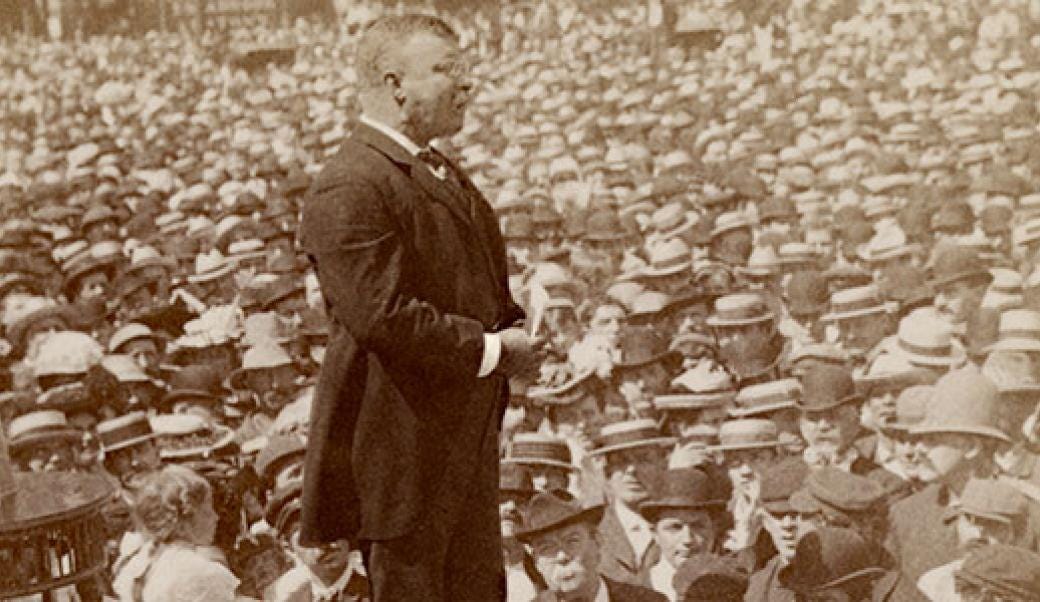
That is what Theodore Roosevelt teaches us about leadership.
Theodore Roosevelt On Leadership
Studying and imitating the great men in history is a far better way to become a good man than simply reading books on principles. There are a multitude of biographies on Theodore Roosevelt that will allow anyone to study and imitate his leadership qualities. There is no substitute for reading the biographies but James Strock has done the best job extracting TR’s leadership principles in his book “Theodore Roosevelt on Leadership.”
Reminder: This publication is entirely reader supported.
To support our mission and to receive additional content, please consider a paid subscription. In return you’ll receive:
Two full length articles each week on Thursday and Sunday.
Access to the community chat and comments section
Full archive of over 150 posts.
