

Great Man Series - Theodore Roosevelt #3
It is up to the man to create the circumstances in which he will become a good man by surrounding himself with other good men, taking up the study, putting his life into order, enduring suffering, and taking proper action.
While much of his formation is up to him, he does not exist in a vacuum. There is one thing that is not up to him: the household to which he is born. A man does not choose his father or mother or anything about the status of their life. A mother and father, by bringing a child into the world, have an obligation to that child (or children). The child’s future, in many ways, is dependent on the two he calls mommy and daddy.
The formation passed through a mother and father will not make a man President or determine the full success of his life. But it is close to impossible for a man to reach the heights of greatness without those initial years of parental love and formation.
The father has the preliminary role in launching a man into the world. Skipping those formative years either by the neglect or absence, or by an undisciplined character the child become man will mostly stall out instead of launch. With great difficulty, he can get his life in order and moving towards the path of greatness. But its far better if he is launched into the world by a great and noble man.
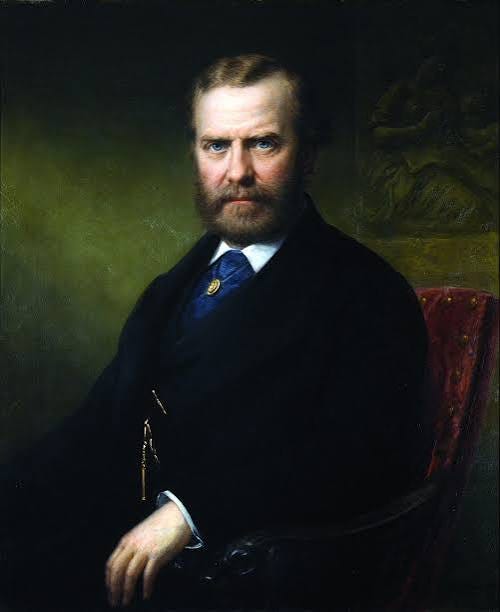
Theodore Roosevelt Sr. understood this. Not only did he launch the 26th president into the world, but he left an impact almost as great as his son did on the state of New York. Arguably more because he was a Kingdom man to his core. We know his name because his son, who surpassed him only in magnanimity, modeled his life after his father and ascended to the Presidency.
Who Was Theodore Roosevelt Sr?
Theodore Roosevelt Sr was the fifth born son of Cornelius Van Schaak Roosevelt, one of the first millionaires in New York. CVS as he was called by the family, was the head of the family business, passed down from four generations. At the time of his death, his personal net worth was $1,346,000 which is approximately $36m in 2026 dollars. As a wedding gift, he purchased each of his son’s homes close to his. Theodore Roosevelt Sr. had a home for his family just six blocks from his father. He was also a Jr. Partner at the family business. Although Theodore Roosevelt Sr. had abundant wealth, he seemed not to care for it too much. He spent much of his life giving it away. His children inherited a nice sum, but it was small compared to what he had received from his father.
Theodore Roosevelt Sr. was a known family man and philanthropist - the two qualities most well known about him. Philanthropist is not the best word to describe his work in the world. He rarely wrote checks without getting deeply involved in whatever he put his mind to do. In Mornings on Horseback, David McCullough captures his intense work ethic when it came to his philanthropic endeavors:
As time went on, his crusades among the needy, his hospital and museum projects, became his true vocation. It was thus that he became one of the prominent men of New York, as truly good a good citizen As New York had ever known. Whatever he did, he did it all out.To some, he seemed strangely driven…Theodore [sr] felt he had no choice. “I feel that as much as I enjoy loafing, there is something higher for which to live.
One of his charitable works was the establishment of a lodging house for young boys. New York had an issue with “street rats” as they were called; homeless children, somewhere around 20,000. He established a house where the boys could stay the night and enjoy a warm meal. He then went into the streets, befriended these lost boys, and invited them to the lodging house. The lodging house would have a Christian service, teach the boys skills, and find a way to reintegrate them with their families. The man who ran the operations of the lodging house asked if Theodore Roosevelt Sr. would spend every other Sunday night with the boys. His response is one of a humble man.
He declined, stating his troublesome conscience would not permit every other Sunday. He would be there every Sunday.
He was there, every Sunday, giving all his effort to get to know the boys and give them hope. And often, he had one of his own children with him, expanding their world from the protected comforts of their wealthy life to be with and serve the most destitute.
Theodore Roosevelt Sr. was a devout Christian, a faith not quite shared by his wife who honored and respected it. He was raised Dutch Reformed and split his worship time between the Dutch Reformed Church and Presbyterian Church near his home. Sunday, the Lord’s Day, was sacred in his home. The whole family was expected to participate, to avoid all work, dress properly, attend church with him (mornings and evenings), to say their prayers, and listen to his bible teachings.
During the Civil War, Theodore Roosevelt Sr. paid someone to take his place in the battalion (the only thing his son would detest about him). Theodore Sr.’s wife was a southerner and he could not bring himself to go to battle against his own family members. But he did not sit at home either. He went on a campaign on behalf of the wives, children, widows, and orphans whose fathers were at war or who had died at war. He lobbied for an allotment system that would deduct soldiers pay and route it back to their home automatically - similar to how modern tax or retirement systems work. It took political machinery and long months to get the task accomplished. He sat before Abraham Lincoln to pitch the idea, received approval, and then spent months convincing soldiers they should deduct money to send home. It is estimated that his allotment program sent over $1m (in 1864 dollars) back to families who had no father at home.
He had earned a family nickname, Greatheart, after the heroic guide in John Bunyan’s Pilgrims Progress. That is how he was remembered, as the great guide through life by family, friends, and mostly, his children.
There have been many great men, known and unknown, who have failed to launch their children into the world the way Theodore Roosevelt Sr. launched his oldest son into the world. His formation methodology is worth examining.
Reminder: This publication is entirely reader supported.
To support our mission and to receive additional content, please consider a paid subscription. In return you’ll receive:
Two full length articles each week on Wednesday and Saturday.
Access to the community chat and comments section
Full archive of over 150 posts.
Mission
Many generations have watched their cities burn and become desolate. When the city is gone, the pillars set in stone remain. So do the lives of the greats - they continue to endure, offering us wisdom for life that can stand like a pillar in stone.
The Institute of Men is a publication writing about the wisdom of the saints, the great men, the philosophers and theologians whose lives give us something to admire, honor, and imitate.